News in Brief


Turkey Reduces Size of Coins
The Turkish State Mint has reduced the size of the lira coins to offset rising minting costs, according to local reports.
The 1 lire and half lira (50 kurus) coins, both of which are bimetallic, are now a half millimetre thinner and have a different composition of copper, zinc and nickel. The weight of the 1 lira coin has been reduced from 8.2g to 6.6g, and the half lira from 6.8g to 5.5g.
The changes, the first in 14 years, are saving 30% in production costs.
New Coin Scanner for Coiniverse
Coiniverse, the mobile app platform developed by the Mint of Finland and now adopted by several mints around the world in association with the collector community, has launched an improved coin scanning feature with improved coin recognition.
The coin scanner utilises a new and improved coin recognition AI model, created in partnership with Emblica – a company that specialises in developing state-of-the-art AI systems. The AI model was designed specifically for coin recognition and, according to Coiniverse, its recognition accuracy has been significantly improved.
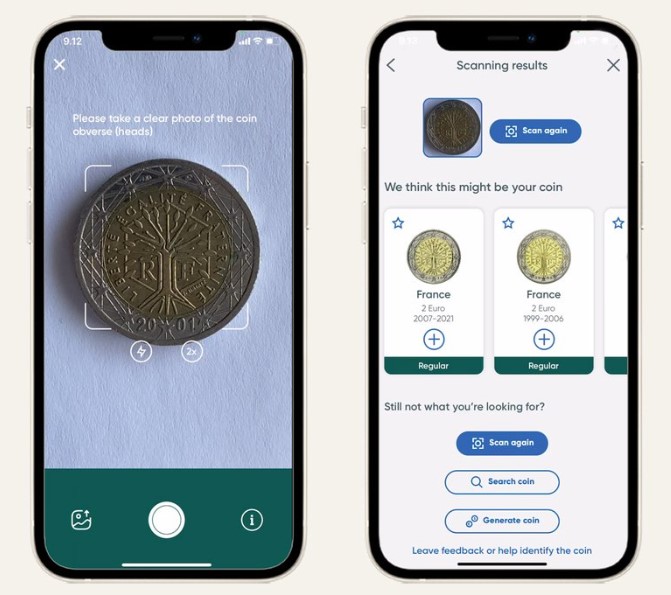
The new coin scanner aims to ease and speed up coin recognition and collection management for Coiniverse users. More information about the scanner and the development process behind the new AI model can be found on the Coiniverse blog here: www.coiniverse.app/blog/introducingnewscanner.
A New Stock Index for Coins
A new ‘stock index’ for numismatic coins – a new numismatic index, called numindex – has been set up with the aim of displaying the price development of a select group of coins in a clear and transparent way.
30 coins, which had previously circulated in Europe, have been selected to become the basis for numindex, with the index displaying the price development of the mentioned set starting from 2018 until today.
The new numismatic index aims to calculate an index that reflects the price movements of European numismatics, to attract new collectors with different backgrounds and knowhow and to make coin collecting more available and understandable. The index has been calculated for the past but is now regularly updated and available on the website, to find out more information visit: www.numindex.com.
Texas Proposes Gold-Backed Digital Currency
Two bills recently introduced into both chambers of the legislature of the US state of Texas – S.B. 2334 and H.B. 4903 – aim to require the state comptroller to establish a digital currency that is backed by gold and which can be redeemed either in gold itself or cash.
The bills state that the comptroller should ‘establish a digital currency that is backed by gold so that each unit of the digital currency issued represents a particular fraction of a troy ounce of gold held in trust’. The value of a unit of the digital currency would be ‘equal to the value of the appropriate fraction of a troy ounce of gold at the time of that transaction’.
The gold reserves that back the currency are proposed to be held in a trust at the Texas Bullion Depository, with no limit on the amount that Texans are able to purchase.
Both the Senate and House bills have been referred to the Finance and State Affairs committees respectively, with the latter left pending in committee as of last week.
TRM Notes Continuing Investment Trend
According to The Royal Mint, recent survey research conducted shows that last year’s trend of increasing investment in gold – a near 26% uplift year-on-year in the number of gold investments – is set to continue.
A recent poll undertaken by the Mint shows that nearly one in four investors (23%) plan to invest in gold this year, with precious metals as the second most popular investment right now, only behind UK stocks and funds. The data also showed that nearly one in six investors (16%) who haven’t previously invested in precious metals before plan to in the future.
This is being driven in part by the asset’s ‘safe haven’ status (53% of the above figure), with 29% motivated by the belief that the asset is less risky than other investments.
Director of Precious Metals, Andrew Dickey, noted that the Mint is ‘seeing more investors consider, and invest in, precious metals as a potential means to protect their portfolios and attempt to navigate volatile market conditions. From our experience, gold and precious metals grow in popularity during challenging times for the global economy as investors look to diversify their portfolios and hedge against inflation.
However, for many risk-conscious investors, these market moments are only a trigger for a long-term investment in precious metals that grows over many decades and retains what many see as its ‘safe haven’ status.’
Mint of Poland Expands to Meet Demand for Gold
The Mint of Poland has announced that it is expanding its gold investment products sales network. In the last two weeks it has launched three new points of sale of gold investment products in Gorzów Wielkopolski, Toruń and Łódź.
According to the Mint, a consistent development of the sales network is its answer to the interest in investments in the yellow bullion, which remains at a very high level. In 2022, sales of precious metal products reached 6 tonnes, of which gold accounted for half.
In 2022, the Mint launched six points of sale (Lublin, Katowice, Białystok, Szczecin, Rzeszów, Gdańsk) and one company store (Wrocław). Further development of gold distribution channels is planned this year. Sales at in-store outlets accounted for 45% of turnover in mint products in 2022.
The Mint has also launched what it terms the most modern online mint sales platform in Europe. In addition to investment gold, it can be used to order silver investment products, diamonds, coins, jewellery and gift products.
Subscriber content
Read the full article
Full access to Coin & Mint News articles, newsletters and archives.