World Money Fair’s 19th Technical Forum Returns as Live Event

The Technical Forum returned as a live event this year when the World Money Fair took place for the 50th time from 3-5 February in Berlin. It was the Technical Forum’s 19th event and the first one live since 2020, having been forced by COVID to hold the two previous years as online events instead.
Whilst the World Money Fair returned in its previous format and experienced high footfall similar to prior years, the Technical Forum returned as both a physical and online event, and in doing so attracted just short of 400 registrations. Allowing for several viewers per online registration, and more subsequent digital viewings following the event, this has to have been a very successful change.
The Forum, which took place on 2 February, featured 14 x 15 minute presentations divided into three sessions. These are available to view online, but in the meantime, below is a short summary of the presentations in the first session. The second and third sessions will be covered in subsequent issues of Coin & Mint News™.
The Technical Forum presentations will be available to view online, so below is a short review of each one with the intention of conveying their key aspects.
Minting/Automation: Medal Press with Smart Feeding System for Fine Gold
Austrian Mint, Gräbener and Economa
Alfred Gnadenberger (Austrian Mint) stated that the objective was to develop a medal press with an automatic feeding system for gold blanks from a bulk system. The specification was for a product range of 20- 50mm, an output of 60 pieces per minute, a process autonomy of 30 minutes and 30 minutes to change products.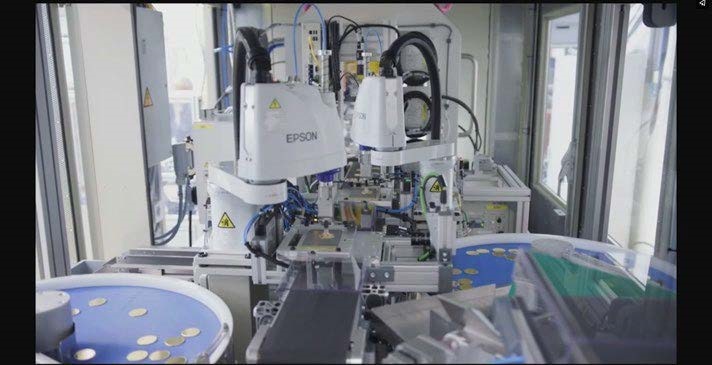
The product specification, based on the Austrian Mint’s main products, was for five Philharmonic coins of 1oz, 1/2oz, 1/4 oz, 1/10 oz and 1/25 oz, in 999.9 fine gold; two coins of 1 and 4 ducats in 986.1 gold; and eight coins in 99.9% copper. The thickness of the coins should be between 0.5mm and 5mm with diameters from 12-50mm.
Next, Alexander Trelenberg of Gräbener and Herman Schürer of Economa described in detail the innovative machine developed to meet the specified requirements. Robotics featured heavily to enable the feeding, striking, and inspection systems to run at 150 coins a minute, The packaging line has options for machine or manual packing.
Alfred Gnadenberger stated that the joint project proved to be a great success.
Noise reduction and vibration levels were significantly reduced, productivity increased by 50-70%, and changeover times and product autonomy were each 30 minutes. He described the project as having achieved the biggest technical improvement in gold bullion presses in the last 30 years.
Production: Implementing New Standards in the Bullion Industry
Bulmint
Nina Yordanova introduced Bulmint as a 20 year old private mint, smelter and refinery, based in Bulgaria. All processes are carried out in house, and it now exports globally. It recently launched a commemorative medal of a national hero, Basil Levski, in pure silver to demonstrate its improved capabilities.
Thomas Köninger then explained how Bulmint has faced increased demands from the market regarding quantity, quality and environmental requirements. The overall challenge has been to become more efficient.
This was achieved by investment in new machinery and automation. Changes included the investment in a new continuous 4 high rolling mill, coin to coin, and the first Spaleck Z24 machine to be installed in the bullion industry. Different operations were linked to create a closed loop system of surface treatment, inspection and minting.
Production efficiency has increased per hour up to 250% with the introduction of the Spaleck Z24, compared with the previous two Z11 machines. Quality standards have been maintained or improved. And, importantly in today’s drive for sustainability, significant environmental improvements have also been achieved.
To date, in surface treatment, water consumption has been reduced by 47-51% and energy by 30-42%. Significant further reductions are planned.
Rolling: Optimisation of Strip and Ingot Production Through Servo-Driven Height-Adjustable Tables in Cold Rolling Mills
Bühler Redex
Dr Ullrich Speer explained the structure and location of the Redex Group of four companies. Bühler Redex, based in Germany, is in the Rolling Mill Division, and is celebrating 150 years this year. It is one of only a small number of companies worldwide that can offer strip machines, flat machines, round wire machines as well as profile machines.
The topic for the Forum covered only the rolling of gold and silver and the problem of Saber formation, and specifically the technical innovation to overcome it by the use of servomotor-driven height-adjustable pusher tables.
This technique using pusher tables is known, but the Bühler Redex system differs in four ways – its method of material guidance, of pushing, its automation, and its servo-based height adjustment system.
A machine with this new technology has been in successful production for a year.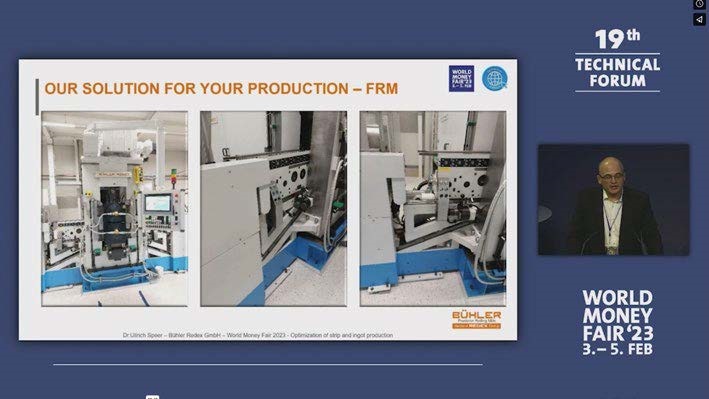
Toolmaking: Highly Complex Mint Designs Reproduce with PECM Machines
PEMTec
Wolfgang Prem provided a brief overview of PEMTec. The company was founded in 1995 and has been owned by the Wacht Group in Germany since 1998. Its R&D and production facility has been based in Forbach, France since 2003.
The ECM (Electro-Chemical Machining) process guarantees surfaces of the highest quality and is used in a number of industries. To achieve greater precision, the PECM (Precision Electro-Chemical Machining) process was developed by minimising the gap between anode and cathode through which an electrolyte solution flows, and by exchanging the electrolyte itself.
The ECM uses an anode and cathode with saltwater (an electrolyte) in between – the cathode produces hydrogen and the cathode oxygen when 1.23 volts are applied. If the voltage is increased, the metal ions move from the anode and deposit on the cathode; this is known as the galvanic or ECM process. But, if the liquid between the anode and the cathode is flushed effectively between depositions, then this galvanic process is prevented. This is the principle of the PECM electrochemical processes.
However, PEMTec has created its own version of the PECM process that allows extended deposition times in the gaps of 1-3 microns between the anode and cathode. It has coined the word ‘Pemming’ as a trademark to clearly differentiate its unique non-contact machining technology.
The electrode’s shape is created inversely onto the metal with an accuracy in the lower micrometer range and surface accuracy of 0.03 micrometers. The product is burr free and contactless, the process is cold, micro-cracks cannot be created (which could be one reason why the dies last longer), there are no structural changes, white layers are not created and the grain structure is unchanged.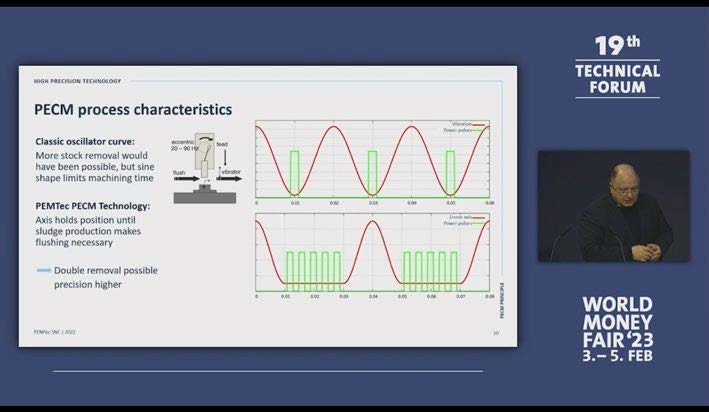
The advantages in daily production are numerous, said Wolfgang Prem, including ready to use dies, no safety issues, and improved surface quality, which reflects the electrodes shape by 100%.
Other benefits include high quality relief, no need to harden the dies, longer lifetime of dies, dies produced in half the time, and a wide range of materials for the electrodes.
Digital Suite: Efficiency Increase in Your Coin Production
Schuler
Wolfgang Schumann and Stephanie Apprich combined in a question and answer session to convey the capabilities of Schuler’s Digital Suite. The leading question, posed by the newcomer (Stephanie) to the experienced manager (Wolfgang) was ‘would you like to make 50% more coins this year?’.
The proposed answer, simply increasing the speed of the mahcines, was countered by the statement that the issue is far more complex than that. But Schuler’s Digital Suite, connected to one of Schuler’s latest machines, could provide some answers.
The Digital Suite is designed to provide information which, on analysis, could indicate deviations from standards or expected results, point to existing issues and even developing issues. It has a maintenance application that monitors key functions and indicates when maintenance are required. Both current and historic data is available for review, comparison and analysis. Even aspects such as energy consumption in different periods could be compared.
In short, the Digital Suite is there to help management better understand all aspects of production by providing transparency through the provision of detailed data, both regularly and by interrogation. This information is there to enable management to deal with any abnormal situation, such as a batch of dies underperforming in one or more ways, or one shift underperforming compared with other shifts using the same materials and equipment.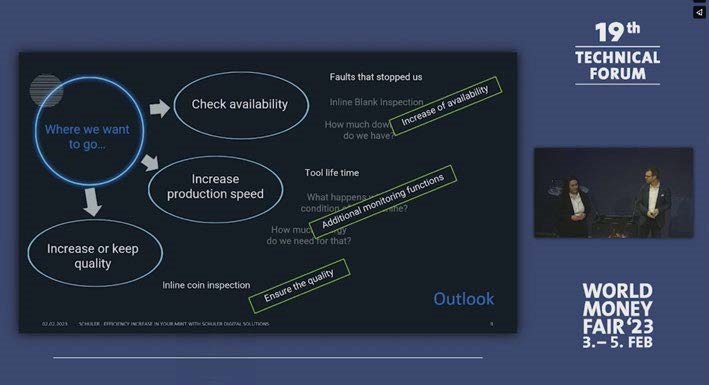
Subscriber content
Read the full article
Full access to Coin & Mint News articles, newsletters and archives.