Spain’s Coin Circulation and Management

At the Coin Conference in Amsterdam last October, Beatriz Guia of Banco de España provided an overview of Spain’s coin circulation and management. This article is based on that presentation, with an update following the publication of the BdE’s annual report this summer.
In Spain, coins are produced by the national mint (Fábrica Nacional de Moneda y Timbre, aka FNMT) with the Treasury as the customer. The Mint and the Banco de España (BdE) are responsible for primary distribution, logistics and stock management. Cash in transit (CIT) companies work with the financial institutions to distribute the coins and the commercial sector looks after cash usage.
The BdE has 15 branches, a central warehouse providing coin distribution to 57 CIT centres owned by Prosegur, Loomis and Trablisa. Coins are distributed on demand, with no transport fees charged.
BdE works to Regulation (EU) No 1210/2010 for the authentication of euro coins and the handling of euro coins found to be unfit for circulation. BdE is required to do on the spot controls of at least 25% of machines and to produce inspection reports. The controls check on the coin-processing machines, the organisations written policies and procedures, appropriate Human Health Risk Resources, how counterfeit euro coins and coins found to be unfit for circulation are handled and the holding of stocks at the CIT.
BdE works with the Coin National Analysis Centre to ensure that the CIT centres have been visited and the right number of coin-processing machines have been inspected. In 2022, 44% were visited, and around 974 million €2, €1 and 50 cent coins verified.
Any non-compliance must be followed up on. Counterfeit coins are required to have been submitted to BdE within 15 days after having been identified. Machine owners must have the correct control certificates confirming their machine comply with the EU Regulation and its list of approved machines.
26,75 counterfeits coins were withdrawn, a decrease of 10% when compared with 2021. No counterfeits were withdrawn prior to circulation.
Net issuance of coins
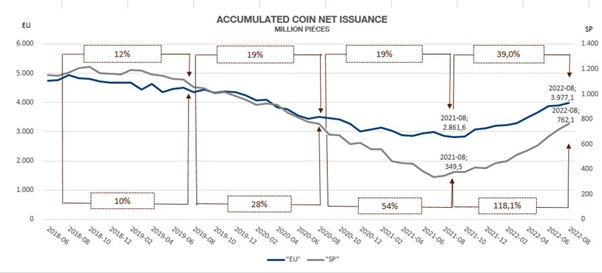
Spain’s net accumulated issuance of coins largely tracked the EU average between June 2018 and April 2020. After that it both dropped by more and then recovered by more than the EU average, 54% drop compared with 19% and a 118% rise compared with 39%.
Net issuance of coins at the end of 2022 was 794 million pieces (€172 million), almost double and six times, respectively, higher than in 2021. Issuance was concentrated in the three lowest denominations (65.3%). Of the higher denominations, the coin most in demand was the €1 (13.5%), in contrast to the Eurosystem area as a whole, where the preference is for the €2 coin.
 Banco de EspañaCoin distribution to CIT centres has steadily decreased since 2016, although 2022 appears to been a year of recovery. In 2022, BdE stocks returned to 2016 levels, although CIT stocks have been decreasing since 2020, albeit only slightly. The production of coins has fallen by a third since 2016.
New initiatives
Two projects have been completed and three are still in progress. BdE has implemented new software to register and manage coin requests and it has developed and deployed a new application to manage and control cash stocks.
It is in the process of installing coin collection machines on its premises, is carrying out an internal assessment of its coin distribution network relative to the needs of the public and the commercial sector, and it is carrying out a programme to promote its stock mobilisation agreement, which includes on the spot controls and coin distribution management.
Looking to the future
As tourism returns, BdE expects coin demand to recover, which will increase both overall demand and the range of denominations needed. It is also expecting new agents to enter the market to handle coins.
Longer term challenges include promoting the stock mobilisation agreement, improving coin withdrawal request lead times and seeking to increase the rate of return of low value coins. There is discussion about introducing price rounding so that one and two cent coins are not needed. Were this to happen, this will require careful management.
Subscriber content
Read the full article
Full access to Coin & Mint News articles, newsletters and archives.