Germany’s High Coin Demand Driven by Domestic Demand


The Bundesbank (BBk) provides 25.5% of the fully paid capital that underpins the European Central Bank (ECB), but it has brought into circulation 29.9% of the value of coins in circulation (€8.46 billion). This figure has been stable for some time.
Is this because Germany uses more coins than other countries or because the flow of coins out of Germany exceeds the flow of coins in? There is an assumption it is because of an outflow. If true, then Germany is earning extra revenue from these coins over and above its own indent.
The BBk discussion paper 49/2020 by Matthias Uhl. ‘Coin Migration Between Germany and Other Euro Area Countries’, seeks to establish the real situation.
The paper builds new models to answer the question. The author differentiates between domestic transaction balances, domestic hoarding and foreign demand to build a comprehensive estimate of coin outflows from Germany of German issued coins.
The models look at coin movements between regions and between the transactional and hoarded roles. This was possible because the BBk collects data on the origin of €2, €1, 0.5 and 0.2 euro cent coins and the author was able, for the first time, to establish coin circulation for Germany and for the other euro system countries.
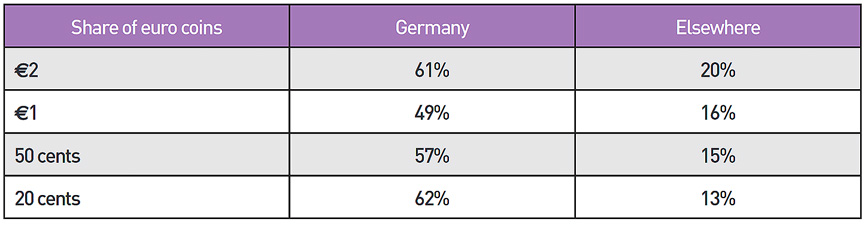 Source: BBk and Mint Director’s Working Group.
The model also uses a mix of transaction balances and assumptions about their evolution.
One important contribution of this paper is that it allows coins to disappear from active circulation into coin hoards. ‘Hoarded’ coins include those saved, collected and those lost.
Two months after the launch of the euro, 68% of Deutschmark coins were still in circulation. In 2011 a study calculated that 36% of Germany’s coins were used for transactions with the remainder hoarded. This gives a sense of the scale of hoarding.
This paper starts with the assumption that the in and outflows of coins are balanced over time and that Germany is not a net exporter of coins. The logic is that, since coin issuance has been stable for some years, there can only be a net outflow if the rest of the euro area has domestic coin demand that is higher than in Germany.
Based on the pattern of coin circulation, the paper set out a hypothesis that coin flows between Germany and the euro area excluding Germany are balanced. It tested this using a calibrated coin mixture model which characterised the movements of coins between regions and between transaction balances and coin hoards.
This modelling of coin migration indicated a convergence of the ratio of German coins to foreign coins in transaction balances in Germany as well as in the euro area excluding Germany.
The main conclusion of the paper was, therefore, that net migration of coins between Germany and other parts of the euro area is small. It concluded that domestic factors explain the relatively large quantity of coins issued by Germany.
Subscriber content
Read the full article
Full access to Coin & Mint News articles, newsletters and archives.