Central Banks Report on Cash and Coins in Circulation


We continue our periodic series of articles on the latest annual reports from central banks and the information they provide on cash, along with circulating and commemorative coins.
Albania
As of end 2022, around 161 million notes were in circulation worth ALL 394.7 billion, an increase of 4.9% and 6% respectively over 2021.
257 million coins were in circulation, compared to 241 million at the end of 2021, 6.6% more. The value of coins reached ALL 6.44 billion, compared to ALL 5.96 billion at the end of 2021, 8% more.
In the year, 343 counterfeit banknotes and 79 counterfeit coins were withdrawn from circulation.
www.bankofalbania.org/Publications/Periodic/Annual_Report/
Colombia
The Central Bank of Colombia’s 2022 annual infrastructure report is predominantly a discussion about a possible future Central Bank Digital Currency in Colombia. It does, however, discuss its 2022 payment survey and cash in circulation.
The survey took part in the first half of 2022 and found that 78.4% of transactions by volume used cash, 74.6% by value. Merchants also preferred cash payments in line with these results.
Coins only account for 2% of the value of cash in circulation.
www.banrep.gov.co/en/publications/financial-infrastructure-report/2022
Denmark
The value of banknotes and coins in circulation fell by 3.2% in 2022. Behind those figures, coins were actually up 0.5% but the fall was driven by a decline in the Kr 1,000 banknote denomination in response to an increase in interest rates in the second half of the year.
In terms of procurement, Danmarks Nationalbank spent Kr 13 million on coins, an increase of nearly 18% compared with 2021.
Eastern Caribbean
In the year March 2023, the Eastern Caribbean Central Bank (ECCB) reported that the value of currency in circulation increased to $1,491.60 million. Banknotes accounted for $1,360.92 million, 91.24%, coins $128.23 million, 8.6%, and digital currency (DXCD) $2.45 million, 0.16%.
The ECCB continued participating in commemorative coin programmes with its international partners, which realised significant receipts in royalties during the financial year.
www.eccb-centralbank.org/publications/report-and-statement-of-accounts
Hungary
In 2022, currency in circulation continued to rise, reaching HUF 8,226.1 billion by the end of the year, representing a 7.2% cent increase compared to the end of the previous year. The expansion was similar to the rise in 2021 (7.1%).
In terms of volume, 668.6 billion notes were in circulation, and 2,354.2 billion coins, up by 7% and 6% respectively. The values and volumes do not include commemorative notes or coins.
Magyar Nemzeti Bank (MNB) issued 28 collector coins in 16 thematic schemes during the year, of which three were gold coins, nine were silver, and 16 were non-ferrous metal collector coins (of which six coins had an independent theme, and ten coins were issued as the non-ferrous metal versions of precious metal coins). Six previously started series were continued, and three new ones were launched in 2022.
Furthermore, 2 million 100 forint commemorative coins were issued to mark the opening of the Money Museum in 2022.
Expenditure on cash production was HUF 11.7 billion in 2022, HUF 0.6 billion more than in the previous year. Of this, HUF 7.4 billion was spent on banknotes, 2% less than in 2021 due to lower volumes. HUF 4.3 billion was spent on the production of circulating coins, 23% higher than 2021 due to coin replacement programmes and higher raw material costs.
The report also provides a brief summary of its subsidiaries. These include Magyar Pénzverő (the Hungarian Mint), which returned a profit of HUF 566 million.
www.mnb.hu/en/publications/reports/annual-report/annual-report-2022
Indonesia
In 2022, the value of cash in circulation in Indonesia rose by 6.95% to IDR 52,545.8 billion.
As part of its work to be a leading digital central bank, BI has digitised every stage of its Rupiah Currency Management, from planning to end of life for rupiah currency, allowing automation and integration that reduces human intervention. This digitisation is being phased in at all Cash Depositories.
www.bi.go.id/id/publikasi/laporan/Documents/Laporan-Keuangan-Tahunan-BI-2022.pdf
Kosovo
Kosovo uses the euro as its legal currency, despite not being part of the European Union or the eurozone, or having a formal agreement with the European Central Bank. Unlike other countries that use the euro under formal arrangements and have their own versions of euro coins, Kosovo does not mint its own coins.
The overall value of cash supply in 2022 marked a moderate increase of 1.5% compared to 2021. The Central Bank of Kosovo supplied the banking sector with over 19.02 million euro banknotes (worth €981.5 million) and over 10.54 million euro coins (worth €1.62 million ).
Demand for coins increased by around 36.2% compared with 2021. Demand was dominated by the small value coins (1, 2 and 5 euro cents), which together increased by 40.8% and made up 67.4% of the total supplied. The supply of €2 , €1 coins and 50, 20 and 10 euro cents increased by 27.5% compared to the previous year.
https://bqk-kos.org/publications/cbk-annual-report/?lang=en
Liberia
The Central Bank of Liberia (CBL) successfully implemented a currency exchange program for a new series of notes and coins. A significant portion of the old Liberian currency will be withdrawn from circulation and replaced with the new currency by the end of 2023.
The stock of Liberian dollar currency in circulation (CIC) at end-December 2022 grew by 8.8% to L$26,198.43 million, primarily induced by 37.3% growth in currency held in banks. CIC and currency outside banks expanded by 9.0% and 8.3% respectively.
CBL was authorised to print and mint new Liberian currency over 2021, 2022 and 2024. Delivery started in November 2021 and issue was begun at once due to a short-term liquidity requirement. The next delivery was in February 2022 allowing the start of a gradual replacement programme.
The value of coins bought by CBL was L$0.463. Nearly 72% of the total (including banknotes in this figure) had been delivered by the end of 2022 with the balance to be delivered in 2024. The coin denominations are the L$20, L$10, and L$5.
https://www.cbl.org.lr/sites/default/files/documents/CBL_2022_ANNUAL_REPORT.pdf
Morocco
Following a 6% increase in 2021, banknote circulation increased by 10% in 2022 to reach 372 billion dirhams. Banknotes rose 9.3% to 2.5 billion, equivalent to 368 billion dirhams, while coins increased by 3.1% to 3.1 billion, equivalent to 4 billion dirhams. The 200 dirham dominated the banknote denominations with a 56% share, and the 1 dirham the coin denominations, with a 29% share.
Bank Al-Maghrib produced 530 million banknotes and 95 million coins. To meet the growing demand for cash, the Bank increased their supply of banknotes and coins by 13.5% to 3.5 billion.
The Bank also issued a gold commemorative coin with a face value of 1,000 dirhams to celebrate the 59th birthday of HM King Mohammed VI, along with a gold coin with a face value of 1,000 dirhams and a silver coin with a face value of 250 dirhams to mark the 23rd anniversary of his enthronement. It also issued a silver medal to mark the 20th anniversary of the Central Bank Museum.
Philippines
Bangko Sentral ng Pilipinas (BSP) produced 2.3 billion banknotes and 1.3 billion coins in 2022. In addition, it produced 1,440 presidential medals and state decorations, 5,943 commemorative coins, and 3,632 commemorative medals.
To avoid the recurrence of accumulating a high volume of coins needing disposal, BSP has bought a low-capacity coins defacement machine (CDM) and is actively defacing newly received CUMD coins. Currently, the machine operates at an average of 60 bags or 120,000 pieces of defaced coins each day.
BSP has carried out a study on the shift to a coinless society. It looked at the experiences and policies of selected central banks with the aim of accelerating adoption and use of digital payment platforms in the Philippines.
www.bsp.gov.ph/Media_And_Research/Annual%20Report/annrep2022.pdf
South Korea
The value of the currency in circulation in South Korea reached 174.8623 trillion won in 2022, a slight increase of 4.4% from the end of 2021.
The Bank of Korea issued seven types of commemorative coins during the year, to celebrate three occasions – the Korean National Parks series, the 25th World Scout Jamboree and the successful launch of the Nuri Rocket.
Meanwhile the Korean state-owned supplier of coins and banknotes, KOMSCO, produced and supplied the BoK with 710 million banknotes, 6.6% less owing primarily to the decline in 50,000 won banknotes in circulation. Coin circulation was 82.7 million coins in 2022, down 14.1% from the previous year. The coin reduction was due to a general decrease in demand.
The total value of the produced currency amounted to 19.9614 trillion won, a decrease of 26.9% year-on-year.
http://www.bok.or.kr/eng/bbs/E0000740/view.do?nttId=10078310&menuNo=400221&pageIndex=1
Taiwan
At the end of 2022, currency in circulation had reached NT$3,356.8 billion, up 13.85% compared with the year before. As usual, currency issue peaked at NT$3,390.1 billion on 28 January, the last business day before the Lunar New Year holidays.
The ratio of currency in circulation to GDP continued to rise in 2022 as in previous years, reaching 12.56%, up slightly on 2021 when it was 11.67%.
In addition to currency issuance, the Taiwanese central bank issues gold and silver coins and commemorative coins for important ceremonies, national holidays, major international events, or other significant national events. During 2022, the Bank issued a casting set of coins for the Chinese Zodiac Year of the Tiger.
www.cbc.gov.tw/en/cp-776-157888-37be0-2.html
Kazakhstan
During 2022, the value of cash in circulation in Kazakhstan expanded by 10.8%.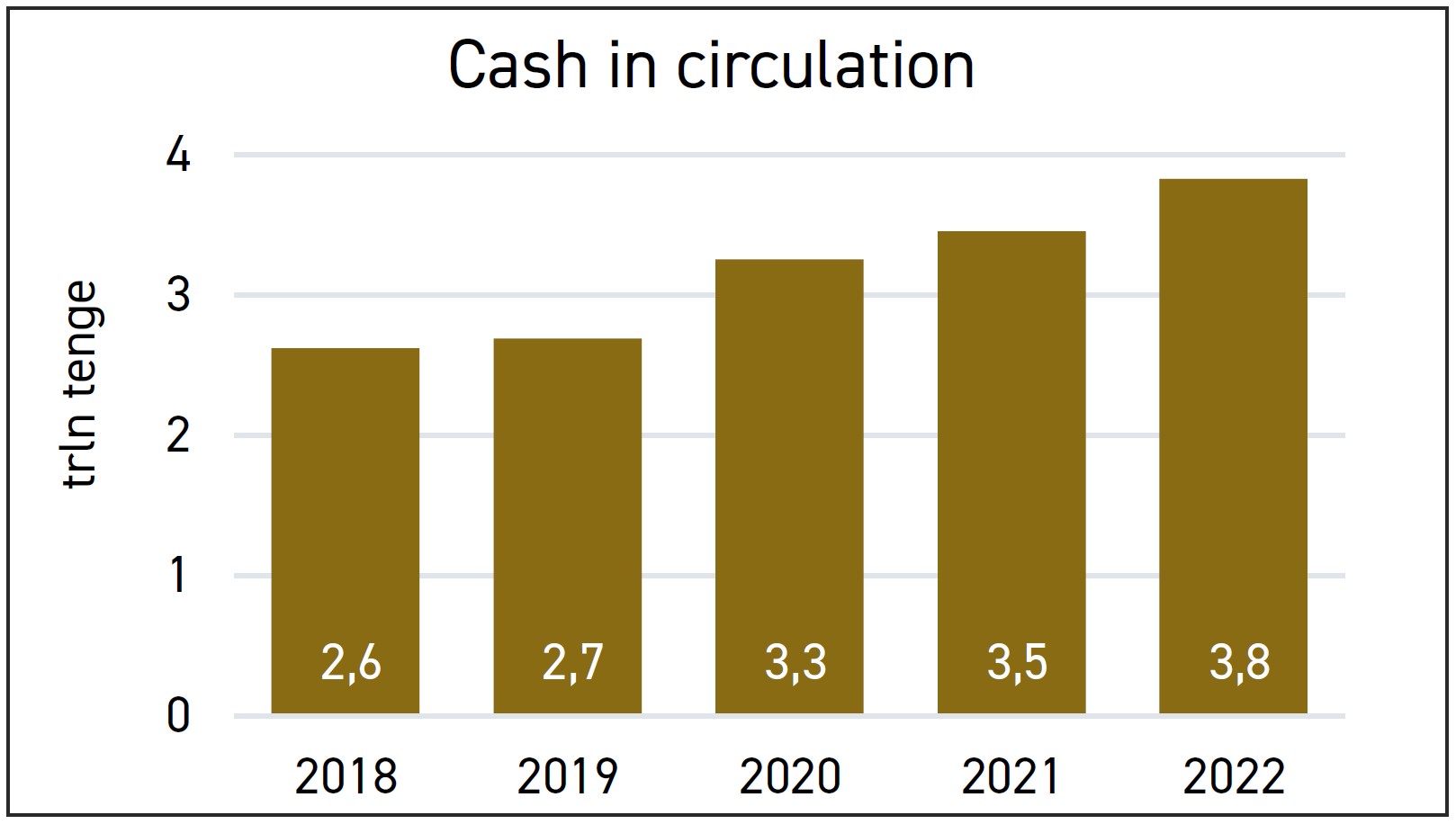
Banknotes accounted for the most significant portion. At the end of 2022, the value of banknotes was 3.7 trillion tenge; for circulating coins it was 91.2 billion tenge.
The National Bank of Kazakhstan (NBK) is constructing new cash centres in the cities of Astana and Aktobe. In the future, cash supply to the regions of Kazakhstan will be carried out from three regional cash centres – the two new ones as well as one in Almaty.
Just over 5.3 million collectible coins were minted and issued, of which 29,500 were made of silver, 140,000 from cupro-nickel and 5.15 million from nickel silver/nickel brass alloy. NBK continued to sell collectible coins via the pilot platform of www.kazcoins.nationalbank.kz – 350,000 collectible coins were sold via the platform in 2022.
In 2017, NBK launched the purchase and sale of minted bars from refined gold. During 2022, its branches sold bullion coins as well. Overall, since 2009, 33,000 gold bullion coins with a weight of 1.2 tonnes and 55,000 silver bullion coins with a weight of 6.6 tons have been sold.
Subscriber content
Read the full article
Full access to Coin & Mint News articles, newsletters and archives.