Zimbabwe Resorts to Specie Coins

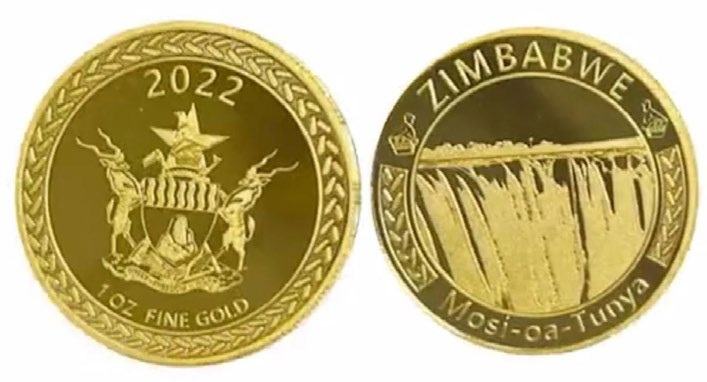
The Reserve Bank of Zimbabwe (RBZ) is issuing gold coins which are specie rather than fiat money in an attempt to stabilise the Zimbabwean currency, bring inflation under control and reduce reliance on the US dollar.
Fiat money is a government-issued currency that is not backed by a physical commodity, such as gold or silver, but rather by the government that issued it. The value of fiat money is derived from the stability of the issuing government, rather than the worth of a commodity backing it. In other words, fiat currencies only have value because the government maintains that value; there is no utility to fiat money in itself.
Specie money, on the other hand, has an intrinsic value as represented by the gold or other precious metal from which it is made. Unlike fiat money, which comprises both paper notes and coins made up of base metals, the value of specie money resides in the value of the metal itself. Specie money – sometime referred to as commodity money – is not used for transactions, except, now, in Zimbabwe.
One danger of fiat money is that governments can print too much of it, resulting in hyperinflation. Which is what happened in Zimbabwe.
The gold coins are called Mosi-oa-Tunya, which translates to ‘Smoke that Thunders’, and is a reference to Victoria Falls. The front of each coin depicts Zimbabwe’s heraldry, with the falls appearing on the reverse. The weight and purity of the coin appears under the heraldry.
Each coin has a serial number and can be purchased using Zimbabwe dollars, US dollars, or many other exchangeable foreign currencies (the South African rand is also widely used in Zimbabwe).
The coins are priced based on the international spot price of gold plus modest production costs. The coins can be traded, converted into local currency, used in commerce, or pledged as security against loans.
The principal objective of issuing gold coins for circulation rather than issuing them to be marketed to collectors or speculators is to reduce inflation, which is currently running at 175%. While this is among the highest in the world, it is still a far cry from 15 years ago, when inflation was off the scale and a Z$100 trillion banknote was issued. Shortly after, in 2009, the government temporarily abandoned the Zimbabwe dollar and legalised the use of foreign currencies.
As well as slowing inflation by providing a store of value for the nation’s currency, the specie coins are designed to give the public an alternative to the dollar. In addition, the cost of importing dollars – along with bond coins, which were introduced in 2016 at par with the US dollar and are produced in South Africa – is expensive and, in the case of the former, in short supply.
Zimbabwe does have the advantage that, relative to its geographic size, it has the second largest gold deposits in the world. About 60% of this is mined by the artisanal mining sector and, officially at least, all gold should be sold to the state monopoly Fidelity Printers and Refinery, which is controlled by the RBZ.
Subscriber content
Read the full article
Full access to Coin & Mint News articles, newsletters and archives.