Central Banks Report on Coins in Circulation


We continue our periodic series of articles on the latest annual reports from central banks and the information they provide on circulating and commemorative coins.
European Central Bank
The European Central Bank (ECB) is not responsible for coins in the Eurosystem; that sits with the European Commission and the National Central Banks and/or finance ministries.
But in its latest annual report, the ECB notes that the value of euro coin circulation also grew by 4% reaching €32.5 billion at the end of 2022, 145 billion euro coins in total.
Spain
In 2022, Banco de España (BdE) put 845 million coins into circulation, equivalent to €208.8 million, a 65.5% increase in relation to 2021 figures, and only 6.6% less than prior to the pandemic.
Net issuance of coins in Spain in 2022 was 794 million pieces or €172 million, almost double and six times more, respectively, than in 2021.
Net issuance was concentrated, 65.3%, in coins of the small denomination (1, 2 and 5 cents), while the coin in most demand was the €1 face value (13.5% of the total). This is in contrast to the Eurosystem area as a whole, where the €2 coin was the preferred coin.
BdE checked approximately 974 million €2, €1 and €0.50 coins, 56% of all coins checked.
Regarding counterfeits, 26,175 counterfeit euro coins were withdrawn from circulation by BdE in 2022, a decrease of 10% compared with 2021. The ratio was 7 ppm. Over 90% of the counterfeits were the €2 coin. No counterfeit coins were withdrawn prior to circulation. The BdE noted the better quality, and hence danger, of the counterfeits detected.
Latvia
At the end of 2022, the total net issuance of euro banknotes and coins of Latvijas Banka was €75.7 million. Net issuance of euro coins increased by 6.3%, reaching 454.5 million coins at the end of December. The one cent and two cent coins were the most popular coins in circulation at the end of 2022.
The annual report of Latvijas Banka refers to the importance of coins as a national symbol. This is the Bank’s 100th anniversary year and its celebrations included a coin art exhibition at the Latvian National Museum of Art. The exhibition, ‘Our Values’, was based on the idea that money can serve as an important symbol of Latvia’s image and national values. The exhibition attracted almost 73,000 visitors, becoming the third most visited exhibition of the Latvian National Museum of Art over the last 30 years.
In the context of Russia’s invasion of Ukraine, the role of Latvian coins telling its story across Europe was noted. To support Ukraine, the bank issued a collector coin in 2022 (‘For the Freedom of Ukraine’) and a €2 commemorative coin in 2023.
In 2022 the bank also issued Satversme 100, Vilhelms Purvītis and Upward numismatics. A €2 commemorative coin dedicated to financial literacy and a €2 commemorative coin celebrating 35 years of the European Commission’s Erasmus programme were issued.
In 2022, 984 counterfeit banknotes and coins were received from circulation and identified (494 counterfeit banknotes and 490 counterfeit coins), an increase of over 28% compared to 2021. While the number of counterfeit euro banknotes decreased by 9%, the number of counterfeit coins increased by 118%. Despite that, counterfeiting remains less than five counterfeits per 10,000 people. The €2 coin was the most counterfeited making up 90% of the counterfeits. The €1 and 50 cent coins were not more than 5% each of the total.
India
The total value of coins in circulation increased by 8.1% in 2022-23, while the total volume increased by 2.6%. The Rs1, 2 and 5 accounted for 83.1% of the volume and 72.3% of the value in circulation.
The indent and supply for coins was 25% higher in 2022-23 than the previous year at 1 billion pieces.
A country-wide survey on the usage of coins, banknotes and digital modes of payment was carried out. The goal was to assess the demand for coins and banknotes, factors influencing the demand, reasons for any lack of demand, the extent and preference for usage of notes, coins and digital modes of payments and shortages/surfeits (seasonal/denominational).
A public awareness campaign was run on SMS, FM radio and digital media websites to encourage wider acceptance of coins by the public. The campaign focused on dispelling misconceptions and allaying fears about coins of different designs of the same denomination in circulation.
A pilot project on mobile coin vans (MCVs) was run for the distribution of coins. The focus was on the remotest parts of the country, with MCVs operating from 1 October 2022. This may be extended to other areas depending on results.
A further measure to increase access to coins is a pilot project using a dynamic Quick Response (QR) code-based coin vending machine (QCVM) using the Unified Payments Interface, or UPI (see CMN December 2022). At the moment most coins are distributed across bank branch counters.
The QCVM pilot is being run with five banks in 19 locations in 12 cities across the country.
People scan a QR code generated by the vending machine using a mobile phone. Payment is made through UPI and the vending machine then dispenses coins. People can choose the quantity and denomination of coins they want.
The RBI has also offered banks enhanced incentives to distribute coins and the holding of coin ‘melas’ by currency chest branches.
Peru
The Banco Central De Reserva Del Perú is in the process of renewing the coin series, celebrating images and the history of personalities active in gaining independence for Peru. The fourth, fifth and sixth coins out of the nine Alpaca coin series were issued. Two commemorative silver legal tender coins were issued, one celebrating the centennial of the foundation of the central bank and the other the bicentennial of the Congress of the Republic.
The volume of coins issued rose 6% and the value 6.8%. The CAGR since 2018 is 2%. The 10 cent coin accounted for the largest share of the volume of coins issued.
The National Mint produced 324 million coins, 30% more than in 2021. No coins were destroyed. The 10 and 20 céntimos are made of brass, the 50 céntimos and S/1 from nickel-silver and the S/2 and S/5 are bi-metallic.
Tunisia
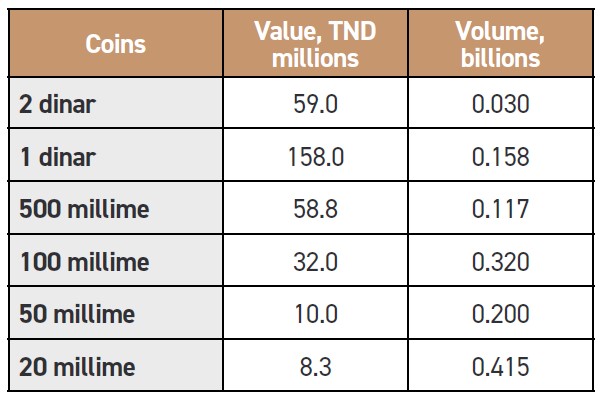
The value of cash in circulation in Tunisia rose by 9.24% in 2022 to TND 18.8 billion. Coins accounted for 2.5% of total cash. In 2021 the value of banknotes in circulation increased by slightly more, 9.4%.
Turkey
The Central Bank of the Republic of Turkey (CBRT) is not responsible for coins but does manage their circulation.
In 2022, to enhance the efficiency of coin cash management, Consignment Coin Depots (CCD) – which have been established in 11 provinces as per the protocol signed between the Postal and Telegraph Corporation (PTT) and the CBRT – continued to operate. In 2022, 75.8% of the country-wide coin transaction volume of TRY 1.15 billion was made by 13 CCDs established on a nationwide basis.
Ukraine
In 2022, the number of banknotes and coins in circulation in Ukraine was about 3 billion, worth UAH 710.5 billion. There were around 14.2 billion small denomination and circulating coins worth UAH 5.5 billion and 23.5 million commemorative and investment coins worth nearly UAH 147 million.
In 2022, the number of banknotes in circulation decreased by 25.1 million, 0.8%, and the number of coins increased by 172.4 million, 1.2%. The 500 hryvnia banknote and the 10 kopilka coin are the most circulated at 26.5% and 28.5%, respectively.
On 1 January 2023, the number of coins per person were 4.3% higher than a year before.
In 2022, the National Bank of Ukraine (NBU) continued withdrawing the 1, 2, 5 and 25 kopilka coins and the 1 and 2 hryvnia banknotes of the 2003-2007 designs, along with the 10 hryvnia circulating coins minted before 2018.
The NBU has issued a series of commemorative and bullion coins in the last year. It sold 1.2 million units for UAH 348.25 million. These have largely been sold to the domestic market, but it is now working with a new international distributor of numismatic products, cooperating with Coins Weekly and a German online publication, Cosmos of Collectibles, and attending international numismatic exhibitions, such as World Money Fair, to increase international sales.
Timor-De-Leste
The Central Bank of Timor-De-Leste uses the US dollar, which it imports from the US, but issues Timor-De-Leste coins (centavos, with 1 centavo = 1 US cent) for use in the economy.
A total of 7.5 million centavo coins were put into circulation during the year 2022, of which 1.6 million centavos of new coins were issued. In 2022, the 200 centavo recorded a total amount in circulation of 545 thousand centavos, representing 7% of the total in circulation.
This denomination continues to show a downward trend, representing a decrease of 46% in 2022, after a drop of 62.2% in 2021. In contrast, the 100 centavo coin registered an increase of 43% after having registered an increase of 54 % in 2021, reaching a value of 4 million centavos in 2022.
The 50 centavos denomination recorded a value in circulation of 1.9 million centavos, amounting to 26% of total coins in circulation, with an increase of 34% compared to 2021.
Subscriber content
Read the full article
Full access to Coin & Mint News articles, newsletters and archives.