Euro Commemorative Coins for 2021

The Official Journal of the European Union has published details of the national side of coins issued by members states in 2021.
Ever since the launch of the euro, each member of the eurozone, as well as countries that have formally adopted the euro as their currency (Monaco, Vatican City, Andorra) can issue up to two commemorative coins per year. Only the €2 denomination can be used for commemorative coins. Since the commemorative coins were first introduced in 2004, 325 different versions have been issued.
These coins have the same features and properties and the same common side as normal €2 coins. What makes them different is their commemorative design on the national side, which can be highly symbolic in national terms.
Designing and issuing the coins is the competence of the individual euro countries. The ECB’s role (as it is with all coins) is to approve the maximum volumes of coins that the individual countries may issue.
As per the Journal, 17 countries issued commemorative €2 coins in 2021. Seven of these issued two coins. The total volume of coins minted was just under 54 million. Details can be found here.
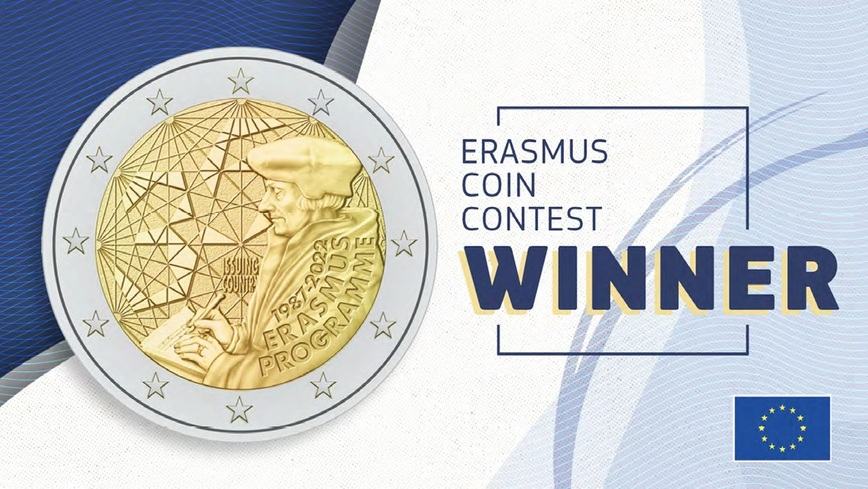
Erasmus honoured in fifth EU-wide coin
In addition to the commemorative coins from each member state, there have been four occasions when an EU-wide €2 coin has been issued. And in 2022 there will be a fifth.
This year’s coin honours the 35th anniversary of the Erasmus Program, a European- based programme that sends exchange students around the world. The design, from the designer Joaquin Jimenex of the Monnaie de Paris, was unveiled earlier this month, having been selected from six options presented for a public online vote.
The design is a mix of two major elements of the Erasmus Program. First is an effigy of Erasmus himself – the Renaissance-era Dutch philosopher, theologian and scholar – who provided the intellectual inspiration for the program.
The second element of the coin’s design comprises beams linking across the coin from one beacon to another, symbolising the program’s intellectual and human exchanges.
The contemporary-styled figure 35 is formed from a treatment of some of the spaces formed between where the beams cross. The outer ring depicts the 12 stars of the European flag.
Unlike standard commemorative €2 coins, there will be one design on the so-called national side regardless of which country issues the coin. Each coin does, however, have a reference to its issuing country, and many have edge lettering unique to the specific country. On Luxembourg coins, meanwhile, in accordance with the country’s law, an effigy of the Grand Duke appears at the top (in the form of a latent image).
Mintages per country are generally a million or less, but range from Malta’s issue of 82,500 coins to Germany’s 20 million coins.
The first EU-wide commemorative coin to be issued was in 2007 to celebrate the 50th anniversary of the Treaty of Rome; the second in 2009 to commemorate the 10th anniversary of the monetary union; the third in 2012 to mark to 10 years of euro cash; and the fourth in 2015, to mark the 30th anniversary of the creation of the EU flag.
Subscriber content
Read the full article
Full access to Coin & Mint News articles, newsletters and archives.