Majority of Europeans Support Current Coins


The European Commission has published the results of its latest Eurobarometer, a survey conducted to measure public perceptions of the euro currency among citizens living in euro-area countries.
During October, 18,667 interviews were conducted over the phone by Ipsos European Public Affairs on behalf of the European Commission, Directorate-General for Economic and Financial Affairs (DG ECFIN). Respondents were asked whether they thought having the euro is a good or bad thing for the EU, with most (79%) answering positively, whilst 69% agreed that the euro is a good thing for their country specifically.
Distinguishing and handling euro coins
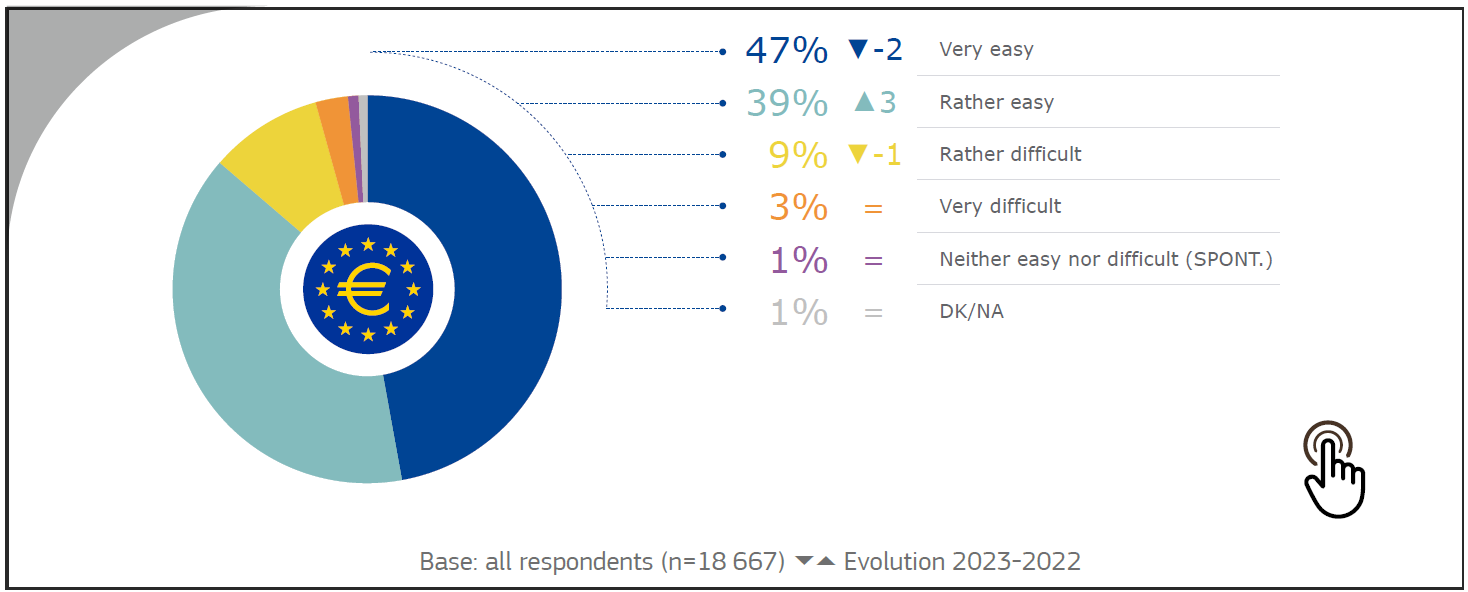
The survey also asked for responses regarding citizens’ satisfaction with the current euro banknotes and coins. In terms of coins, nearly half (47%) of respondents said that they found it ‘very easy’ to handle euro coins, with nearly two-fifths (39%) finding coin handling ‘rather easy’. More than one in ten found distinguishing and handling euro coins difficult, with 9% saying that it was ‘rather difficult’ and 3% ‘very difficult’.
Respondents in Croatia found the most difficulty with coin usage, with the lowest proportion (56%) of all euro-area countries noting that they found it easy to distinguish and handle coins when making cash payments. This is perhaps unsurprising given that the country only joined the eurozone at the beginning of this year. At least three-quarters of respondents in other countries noted ease of use, with the highest proportion observed in Finland (97%), and the lowest in the Netherlands (79%).
Those who said they found it difficult to distinguish and handle euro coins when paying cash – 12% of those surveyed in total – were asked with which coins they have difficulties.
Respondents tended have difficulties with the lower denomination coins rather than those of higher value. The response was much the same from those having difficulties with the 1 cent coin specifically (68% of this group), and those having the same issues with the 2 cent coin (67%).
This reduces to around half (51%) for the 5 cent coin, around one-third for the 20 cent (33%) and 10 cent (31%) coins, and again to 22% for the 50 cent coin. Around one in ten respondents noted difficulties with the €1 (9%) and €2 (8%) coins.
Satisfaction with the current selection of euro coins
The percentage of respondents satisfied with the current selection of euro coins remains much the same as that of last year’s survey – with two-thirds (67%) agreeing that the number of euro coin denominations (eight) is just right. However, this varies widely between countries. Finnish respondents registered the highest level of agreement (89%), whilst Italian respondents noted the lowest level (55%).
The European Commission’s report notes that although there was a broad upward trend between 2011 and 2017 in the proportion of respondents saying that there are too many euro coins, this decreased 7% between the 2018 and 2022 surveys and now sits at 26%.
41% of respondents in Italy and Estonia said that there are too many euro coin denominations, followed by Austria (32%) and Croatia (31%). Estonia and Lithuania show the highest increase in those agreeing with this statement, with both up by 9% from the previous year. Conversely, Slovakian respondents’ agreement with this statement decreased the most in the same period, down by 11% – although the country did abolish the 1 and 2 cent coins in July 2022.
Majority in favour of abolishing 1 and 2 cent coins
Interestingly, and perhaps unsurprisingly, when all respondents were asked specifically about abolishing 1 and 2 cent coins (by rounding final purchase prices), more than twice as many (66%) agreed with their withdrawal as those that said there are too many coins.
Again, the trend of those in favour of withdrawing these coins mirrors that of previous years, when looking at the euro-area countries together, with the percentage approval increasing from 60% in 2011 to 67% in March 2021 and then decreasing to 64% last year – but all above three-fifths of respondents.
In terms of country specific responses, support for abolishing the two lowest denomination coins increased significantly in Austria, up by 5%. Belgium noted almost the reverse, with support for the removal of the 1 and 2 cent coins decreasing by 6% compared to the same time last year.
Just 32% of respondents were opposed to the abolishment of the lowest denomination coins.
The report also notes that it is important to consider that whilst these coins are legal tender in all euro-area countries, there are various forms of national legislation that enforce or encourage the rounding of euro coins to 5 cents, specifically in Belgium, Finland, Ireland, Italy, the Netherlands and, as previously noted, Slovakia.
The Eurobarometer also surveyed European attitudes towards the euro and European identity, the impact of the euro on prices, economic reforms, and the EU’s recovery plan. The full report can be found here.
Subscriber content
Read the full article
Full access to Coin & Mint News articles, newsletters and archives.